The Story
From vision to reality — the complete story of how the Sundial Bridge came to span the Sacramento River.
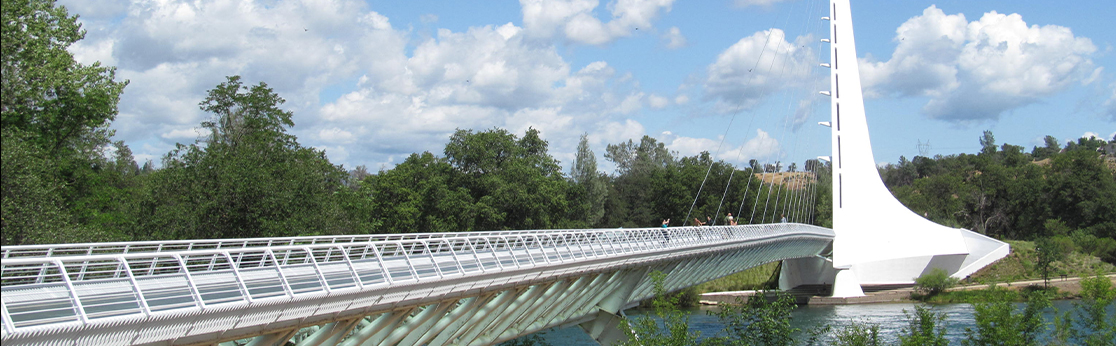
Photo by: Doug Keer
Taken May 17, 2013
Source: Wikimedia Commons
Planning & Conception
The city of Redding began planning for a pedestrian bridge across the Sacramento River as part of a broader effort to connect and revitalize Turtle Bay Exploration Park. The city initially budgeted approximately $3 million for a functional pedestrian crossing. The idea gained momentum as Turtle Bay's north and south campuses — separated by the river — needed a landmark connection point. Redding's position as one of California's sunniest cities was a natural backdrop for what would become a bridge doubling as a giant sundial.
Santiago Calatrava Selected & Commissioned
The McConnell Foundation — a private, independent foundation established in Redding in 1964 — championed bringing world-renowned Spanish architect and engineer Santiago Calatrava to the project after discovering his work through NBBJ Architects in Seattle. The city agreed to move forward with Calatrava's design in 1996. In 1997, the City of Redding formally commissioned Calatrava, with support from the McConnell Foundation, to design a pedestrian bridge linking the park's museum building on one side of the river to its 200-acre McConnell Arboretum and Gardens on the other. This was to be his first freestanding bridge in the United States. His design — a dramatic inclined steel pylon serving as a giant sundial gnomon — was the most ambitious of three concepts he submitted, and also his personal favorite.
Years of Preparation
Calatrava's unusual design required years of detailed engineering before construction could begin. The project was controversial within the community: some residents supported it while others favored a simpler or more traditional covered bridge, citing cost concerns. Costs escalated significantly from the original $3 million estimate as the scope of Calatrava's design became clear. Kiewit Pacific Co. (Vancouver, Washington) was engaged as general contractor, with Morrison Structures, Inc. of Redding serving as construction engineering manager. Steel detailing was handled by Tensor Engineering, and erection engineering by Buckland & Taylor.
Steel, Glass & Cable
Construction commenced in 2000. Due to the sensitivity of the salmon-spawning habitat on the Sacramento River, no construction equipment or materials could be placed in the water. All steel for the bridge — 580 tons for the pylon and 400 tons for the superstructure — was prefabricated at Universal Structural, Inc. in Vancouver, Washington, and transported to Redding by truck and barge in sections up to 40 feet long. The pylon alone comprised approximately 1,200 individual steel pieces, each a unique irregular shape. Sections were lifted into place using a 240-ton Manitowoc crawler crane.
Completion & Dedication
The Sundial Bridge officially opened on July 4, 2004 — approximately four years after construction began, and three years later than originally planned. The final cost was approximately $23.5 million, up from the original $3 million estimate. The McConnell Foundation provided the majority of funding. Additional funders included the Redding Redevelopment Agency and the Federal Highway Administration. In the fiscal year following opening, Turtle Bay Exploration Park saw a 42% increase in visitation. The bridge was completed without a single lost-time construction accident.
Key Facts
Essential details about the bridge's design, construction, and the materials that make it possible.
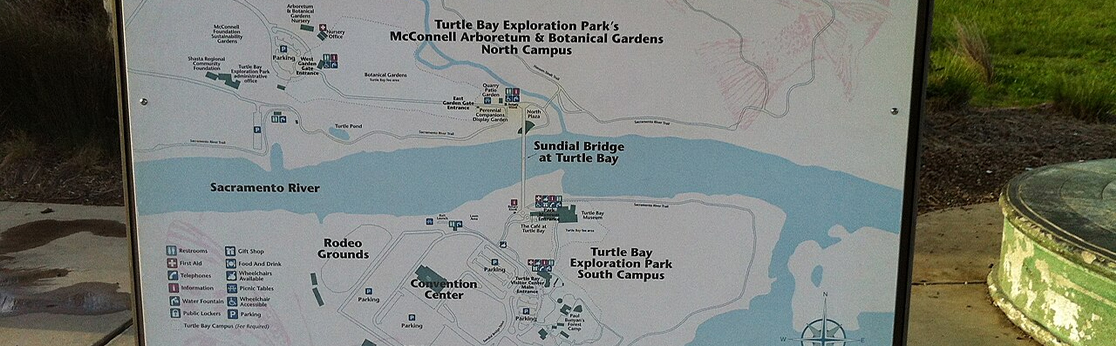
Photo by: Noah_Loverbear
Taken April 5, 2014
Source: Wikimedia Commons
Bridge Span
The bridge spans the Sacramento River with a total length of 700 feet (213 meters). Notably, the structure crosses the river without any supports touching the water — a deliberate design choice to protect the salmon spawning grounds below.
Tower Height
The iconic tilted pylon rises 217 feet (66 m) above the north bank of the river. It leans at 42 degrees from vertical, which approximates — but does not exactly match — Redding's actual latitude of approximately 40.6 degrees.
Construction Timeline
The City of Redding commissioned the bridge in 1997, with construction beginning around 2000. It was completed and officially opened to the public on July 4, 2004. The 217-foot pylon is constructed from 580 tons of steel — not concrete — prefabricated in Vancouver, Washington and transported to the site.
Total Cost
The bridge cost approximately $23.5 million to build. The McConnell Foundation, a private independent foundation based in Redding, funded the majority of the cost (over $20 million). Additional funding came from the Redding Redevelopment Agency and the Federal Highway Administration.
Sundial Function
The tower acts as the gnomon of a sundial, casting its shadow onto a large dial on the north bank of the river. The sundial is only precisely accurate on one day per year — the summer solstice (June 20 or 21) — and is readable only between approximately 11:00 AM and 3:00 PM. The shadow tip moves roughly one foot per minute, making Earth's rotation visible to the naked eye.
Bridge Type
A cantilever spar cable-stayed bridge for pedestrians and cyclists, with a single inclined pylon on the north bank. Unlike traditional cable-stayed bridges, the cables support the bridge deck on one side only — a structural hallmark of the cantilever spar design, which requires the tower to resist both bending and torsional forces.
Materials & Construction
What the bridge is made of, where the materials came from, and how they were fabricated.
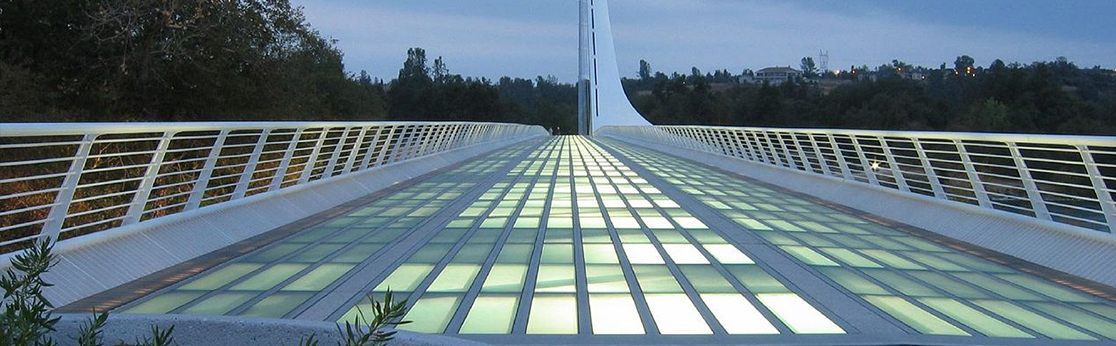
Photo by: David Weekly
Taken October 25, 2005
Source: Wikimedia Commons
| Material | Quantity / Specification | Supplier / Manufacturer | Purpose |
|---|---|---|---|
| Steel (Pylon) | 580 tons | USI Steel Yard, Vancouver, Washington | Forms the 217-foot inclined hollow pylon. Steel plates taper from 1" thick at the base to 5/8" at the top, finished with a white epoxy coating. Pre-fabricated in 25 truckloads and transported to Redding. |
| Steel (Superstructure) | ~400 tons | USI Steel Yard, Vancouver, Washington | Superstructure including 18 deck sections (each 40 feet long), stabilizing steel truss, and cable anchorage nodes. Transported to Redding by truck and barge. |
| Galvanized Steel Cables | 4,342 feet total | Manufactured in England | Cable-stayed support system running from the pylon to the bridge deck. Per the cantilever spar design, cables support the deck on one side only — not symmetrically on both sides. |
| Bridge Deck (Glass & Granite) | ~200 tons (glass & granite combined) | Translucent glass panels from Quebec, Canada; granite accents source unspecified | Non-skid translucent glass panels set in a steel framework with granite accents. The glass deck allows sunlight to filter through to the river below. Illuminated from beneath at night, it glows aquamarine. The deck is 23 feet wide. |
| Ceramic Tile (Sundial Dial & Plaza) | Not specified | Imported from Spain | Broken white tile decorates the sundial dial face and the small plaza beneath the support tower. This is the actual surface on which the pylon's shadow falls to indicate solar time. |
| Foundation (Rebar & Concrete) | 115 tons of rebar + 1,900 cubic yards of concrete | Concrete and rebar sourced locally; general contractor: Kiewit Pacific Co. | Anchors the pylon on the north bank of the Sacramento River. No piers extend into the water — a deliberate design choice to protect salmon spawning grounds beneath the bridge. |
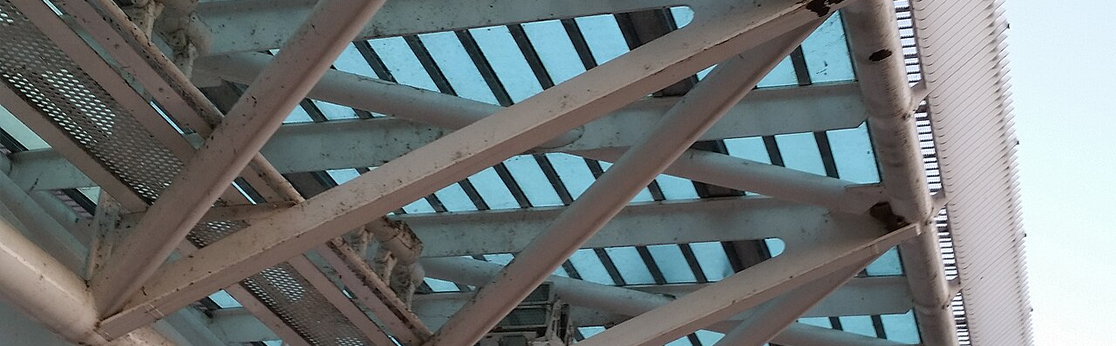
Photo by: cifraser1
Taken August 17, 2014
Source: Wikimedia Commons
Engineering Details
The technical achievements that made this bridge possible.
Foundation Engineering
The pylon foundation uses large-diameter drilled shafts — not driven piles — anchored into the north bank of the Sacramento River. The foundation required 115 tons of rebar and 1,900 cubic yards of concrete. A critical design constraint was that no construction equipment or structure could enter the river, both to protect salmon spawning grounds and to avoid disturbing the riparian habitat.
Steel Pylon Structure
The pylon is a hollow, double-wall steel structure — not concrete — with an internal wall that converges from the base toward the top. Because the internal and external walls were not in the same plane, welding required backing bars at extremely sharp angles, with some sections only accessible for one-sided welding. Internal steel stiffener plates were added after analysis revealed the plates needed reinforcement to hold their complex curved shape under load.
Seismic Design
The bridge was designed to meet California seismic requirements appropriate for the Redding region, which sits in a seismically active zone. The flexible cable-stayed system inherently allows the structure to absorb and dissipate seismic energy through movement. The foundation uses large-diameter drilled shafts rather than driven piles, which better suited the site conditions and Kiewit's construction methods.
Sundial Accuracy
The pylon is angled at 42 degrees from vertical — close to, but not exactly matching, Redding's actual latitude of approximately 40.59°. For a perfectly accurate sundial gnomon, the angle should match the site latitude precisely. As a result, the sundial is not perfectly accurate year-round. The dial face is marked in Pacific Daylight Time (PDT). Time can be read with accuracy of a few minutes; the shadow is approximately 3 feet wide in summer and 10 feet wide in winter. Hour markers and 15-minute interval plaques span an arc from 11:00 AM to 3:00 PM.
Wind & Structural Engineering
The pylon required an extensive 3D finite-element model — developed by erection engineers Buckland & Taylor — to analyze stresses during both construction and permanent loading. The single plane of stay cables attaches off-center to the deck's center of gravity, producing torsional displacements in addition to longitudinal and transverse forces, all of which had to be modeled through every stage of erection.
Fabrication Precision
The pylon alone consisted of approximately 1,200 individual steel pieces, each an irregular polygon cut at unique angles to mate with adjacent plates. Tensor Engineering developed a custom 3D geometric model to detail every piece. Buckland & Taylor then used a separate finite-element model to calculate the center of gravity of each pylon section so it could be lifted and set in exactly the right orientation for bolting and welding.
Contact & Visit
Plan your visit to the Sundial Bridge or get in touch with questions.
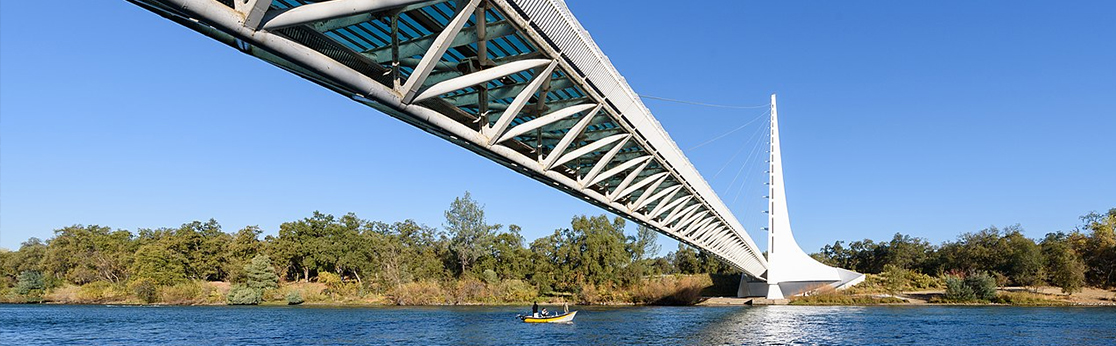
Photo by: King of Hearts
Taken November 2, 2019
Source: Wikimedia Commons
Location
Sundial Bridge Trailhead
100 Bridge Way
Redding, CA 96003
Hours
Open daily
Dawn to Dusk
Free admission
General Inquiries
City of Redding
Parks & Recreation Dept.
info@redding.org
Phone
City Hall:
(530) 245-6200
Trailhead Info:
(530) 247-5900